If you haven't read Patrick Smith
...you're still a tourist.

There is a causeway on Merritt Island named after a man most people driving across it have never read. Admittedly, I was unaware until I moved to the area and saw the lunchbox sized sign. This is how it goes in Florida. You can get a highway named after you and still lose to a Jimmy Buffett compilation at the airport bookstore.
Patrick Smith came down from Mississippi in 1966, which was already late for a state that had been selling itself to strangers since Flagler ran the first rail south. He took a job in public relations at Brevard Community College, a position that must have suited him like a saddle suits a sailfish. He had other plans.
He’d already written The River Is Home at twenty-one, a book about the river-rat people of his childhood, and it was good enough that you could see what was coming. What was coming was Florida. Not the Florida of Mickey Mouse and travel-slop and the relentless, stupefying machinery of coastal development, but the other one. The one underneath. The one that was there before the air conditioning and would be there after; the scrub and the hammock and the black water and the terrible silence of a place that does not care whether you make it through the night.
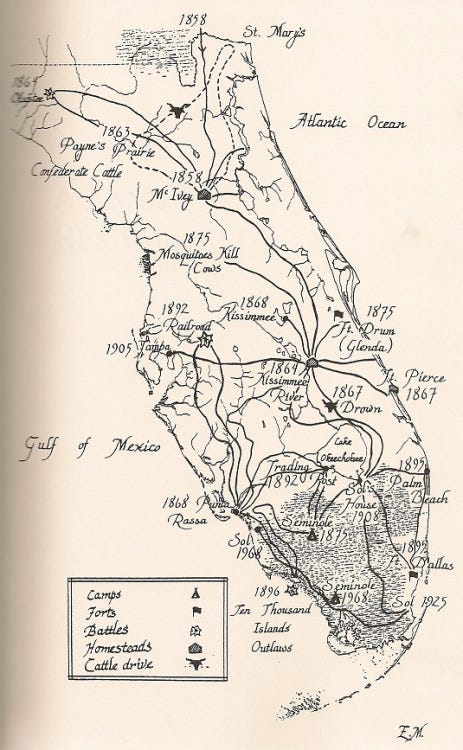
A Land Remembered came out in 1984. It follows three generations of MacIveys from 1858 to 1968. A century’s worth of a family clawing its way up from nothing in the Florida interior, driving wild cattle to Punta Rassa, surviving freezes and hurricanes and mosquitoes that could drain a man like a tap, and then, inevitably, selling it all off to developers in exchange for the kind of money that makes you forget why you wanted it. The arc of the book is the arc of the state. Smith understood that these were the same story.
They nominated him for the Pulitzer three times. They nominated him for the Nobel. The Florida Historical Society invented an award, the Greatest Living Floridian, and gave it to him, and he was only the second living writer to make the Artists Hall of Fame, the first being Marjorie Stoneman Douglas, who had the Everglades on her side. Smith had only the truth, which is a less photogenic constituency.
He wrote six other novels. Forever Island and Allapattah dealt with the Seminoles and the long, familiar American project of pushing people off land they didn’t know they were supposed to own. Angel City was about migrant workers and became a CBS movie, which is a particular kind of afterlife for a serious book. None of it made him rich. None of it made him famous, Florida famous, which requires at minimum a boat, a criminal record, or a cable news appearance.
What Smith had was accuracy. He married a woman named Iris whose family had been in Florida for three generations, and he used the details, names, places, the way people actually talked and moved and died, with the care of a man who understood that the historical record is not improved by decoration. The character of Tobias MacIvey came from Iris’s grandfather’s name. This is how real books get written. You sit at the table with people who were there, and you listen, and then you go to work.
He lived on Merritt Island for nearly fifty years. He died there in January of 2014, at eighty-six. There was no great national reckoning, no rediscovery, no prestige television adaptation. The book just kept selling. It is taught in Florida schools, where I first read it as a mandatory read in 9th grade. It has been voted the best Florida book so many times that the poll has become a formality.
I believe the writers who matter are the ones who make you unable to drive through a place without seeing it differently. Even a place that exists in your bones. After Smith, the Florida interior is not empty. It is full of the ghosts of cattle drives and Seminole camps and freezes that killed the oranges and the people who depended on them. The strip malls and the subdivisions are still there, but now you know what’s underneath, and you cannot unknow it.
They should put that on the lunchbox causeway sign: If you haven’t read Patrick Smith, you’re still a tourist.