The Eighth Wonder
and monk seals

When Juan Ponce de León sailed out of Puerto Rico five hundred years ago, he wasn’t looking for a fountain. He was a supply runner for an empire fueled by human bodies, and his primary mission was slaves. He had a royal contract and a reputation for putting indigenous people in the dirt until they stopped moving. He’d crushed San Juan’s rebellion, been rewarded with land and labor, and been told to go north and find more. The fountain story was just a fairy tale pinned to his corpse decades later, because the truth makes for a lousy statue in a city park.
When he hit the Florida coast in April 1513 there were 300,000 souls already living there. They had inhabited the land for ten thousand years. The Calusa had built canal towns on the southwest coast with a chief who collected tribute from every tribe south of Tampa Bay. They had a warrior class and a government and a civilization that did not need a single thing Ponce de León carried on his ships. He looked at all of it and called it a discovery. He took captives for guides, smashed Calusa canoes, and raped their women. Then he sailed to a scrap of coral called the Dry Tortugas. There, he ordered his men ashore to kill the first living thing they saw: fourteen seals lying in the sun.
The seals did not run.
They had never seen a man before. They were only curious, lifting their heads the way a dog does at a new sound in the driveway. It was an innocent gesture, and the last one they ever made. Around a Spaniard in 1513, curiosity was a death sentence for anything that breathed.
Picture the scene at the Tortugas. A low sandy island. Fourteen animals hauled out on the shore, eight feet long, six hundred pounds, brownish gray with algae growing on their backs so they looked like the reef itself had learned to breathe and drag itself into the light. They lay in groups of twenty or forty or a hundred, stacked on the sand like sunburned tourists at Cocoa Beach, except they had tenure.
There were 300,000 of them in the Caribbean then. Columbus had already killed eight on a beach near Hispaniola the year before. That was the pattern. You land. You slaughter what doesn’t run. You render its body for parts. You write it down in a logbook and call it history.
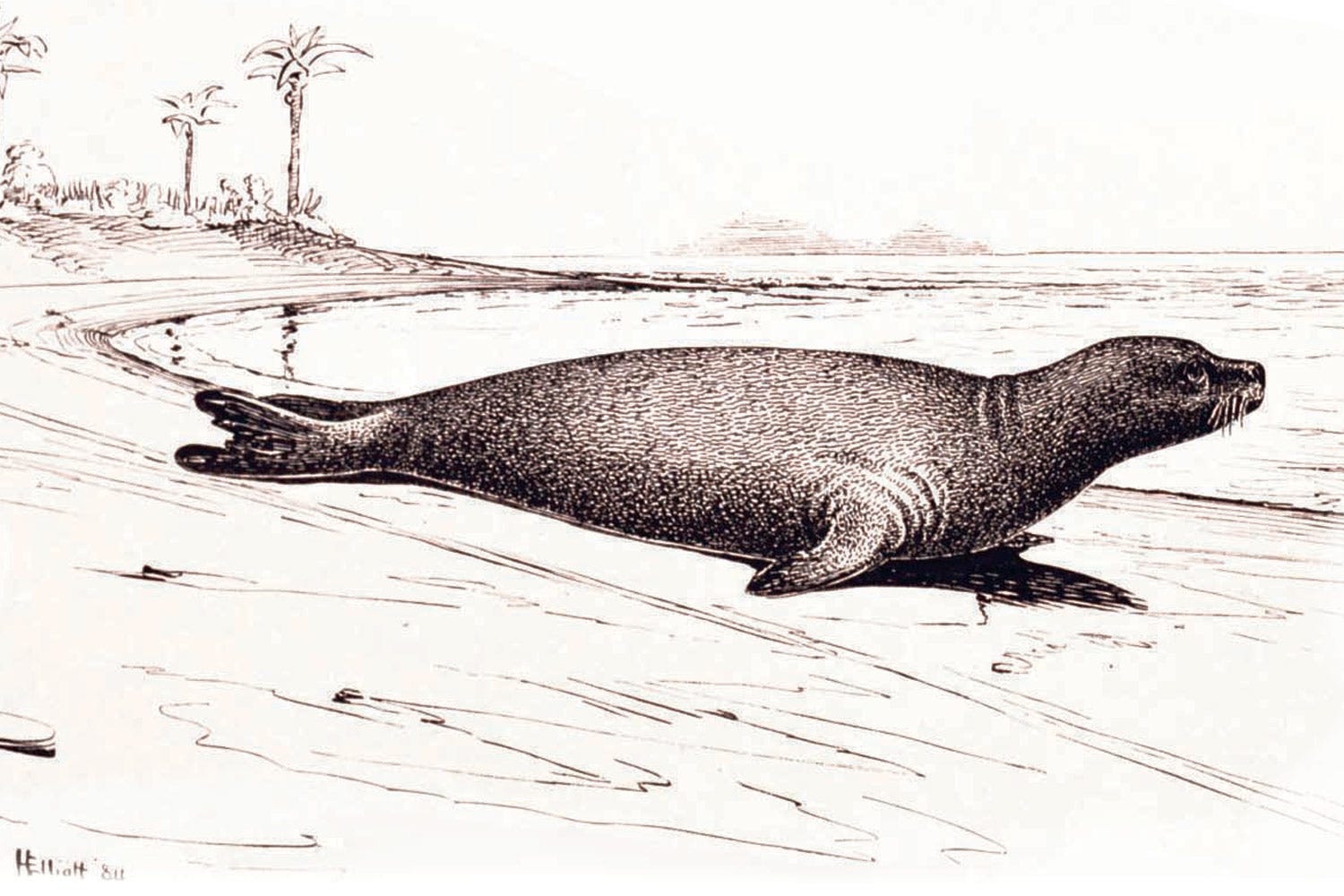
By 1688 Jamaican sugar plantation owners were sending hunting parties out at night to slaughter hundreds of monk seals per session. They boiled them down for oil to grease the machinery. A man named Sloane wrote in 1707 that Bahamian fishers could take a hundred seals in a single evening. By 1850, commerce had abandoned the hunt; there were not enough animals left to turn a profit. The final slaughter was left to science. In 1886, a northern expedition sailed to a reef off Mexico and killed forty-two of the last monk seals on the planet, not for oil, but for display cases in London and Cambridge. Scientists. Naturalists. Enthusiasts. That is the word the record uses. The same word you might use for a man who collects rare stamps, except these men collected the last of a thing, boxed it in sawdust, and called it scholarship.
The pattern set on that beach in the Tortugas became the story of Florida itself: a history of loss written by men from somewhere else who always showed up with a plan.
In 1890 Key West was the largest and wealthiest city in the state. Miami was a mosquito camp with 300 people. The entire population of Florida was 391,000. Egrets and herons and roseate spoonbills nested in rookeries so thick that John Audubon said the flocks blocked out the sun. Flamingos ran in the thousands through the shallows of Florida Bay. The reefs that had fed those 300,000 monk seals held four to six times more fish than any Caribbean reef holds today. That is not poetry. That is a peer-reviewed number. The sheer weight of life needed to feed a quarter-million predators created an underwater kingdom so rich that scientists searching the modern Caribbean have found nothing that even comes close. The Florida that existed before the railroad was a biological kingdom that would be unrecognizable to anyone reading this on a phone in a Publix parking lot.
Then Henry Flagler showed up from New York.
He was a Standard Oil man who saw a tropical wilderness the way Ponce de León saw the Calusa: as raw material. He built hotels, naming one for the slaver himself. He drove his railroad south, city by city, cutting through swamp and bedrock until all that stood between him and Key West was 156 miles of open sea. So he laid the railroad over the ocean itself, a feat the press called the Eighth Wonder of the World. As the first train steamed over the reefs and into the keys, no one thought to call the railroad by its true name: the end of everything that had been there first.
While Flagler was laying track, the plume hunters were killing Florida from the air down. Northern women wanted egret feathers on their hats, and the fashion industry obliged by sending men with shotguns into the Everglades to shoot nesting birds and strip the plumes from their bodies while the chicks starved in the nests above. By 1900 ninety-five percent of Florida’s shorebirds were dead. Ninety-fucking-five. Snowy egret plumes were worth more per ounce than gold, and every ounce of it was shipped north, to New York, to be sold in shops to customers who had no idea what a rookery looked like and no reason to care. In 1905 a game warden named Guy Bradley, America’s first, heard gunshots from his cottage in Flamingo and sailed out to stop a poacher. The poacher, Walter Smith, shot Bradley dead and set his body adrift. A grand jury refused to indict. Years later, a hurricane washed Bradley’s grave at Cape Sable into the sea. In Flamingo, the Audubon Society never hired another warden.
That same decade, 1908, a small group of monk seals was spotted at the Tortugas. The last handful. They were left unprotected. In 1915 fishermen captured six and shipped them to Pensacola. They were released into water that no longer had enough fish to feed them. In 1922 a fisherman killed the last Caribbean monk seal ever recorded in Florida waters, off Key West. The same Key West that had been the largest city in the state thirty years earlier. The same water Ponce de León had sailed through four centuries before with blood on his hands and a royal patent in his pocket.
The species held on in the deep Caribbean for another thirty years. The last one was seen in 1952, on Serranilla Bank, a remote reef in the western Caribbean, drifting between Honduras and Jamaica, closer to nothing than to anywhere. Then, silence. It was the only seal ever hunted to extinction by human hands. NOAA spent five years searching before writing the word extinct in 2008 and closing the file. A parasite that lived only in the seal’s nasal cavity, a mite called Halarachne americana, went with it. An entire organism whose address was the inside of a nose, evicted because its landlord was boiled for lamp oil.
Within eighty years of Ponce de León’s landing, most of Florida’s indigenous population was dead. Slavery, disease, combat. The Calusa, builders of canal towns that commanded tribute across the peninsula, were so thoroughly erased their civilization is now known only through fragments. Their last recorded act was to put an arrow through Ponce de León’s thigh when he returned in 1521 to finish what he started. He crawled back to Havana and died. It is the only satisfying paragraph in five hundred years of Florida history, and still, they hung a fairy tale on the slaver’s corpse: the Fountain of Youth, a myth to make the conquest romantic for the people who showed up later.
Florida’s population in 1900 was 528,000. By the 1920s it was a million. After air conditioning and the interstate highway system, it became a conveyor belt. Today it is twenty-three million and climbing by nine hundred people every single day. Nine hundred more arrivals from somewhere else between one sunrise and the next, piling onto a peninsula that used to hold monk seals and Calusa and clouds of egrets so dense they turned the mangroves white. The reefs are dying. The springs are drying. The Everglades is half the watershed it was a century ago. But the tax code has no state income tax and the winters are warm, so the conveyor belt keeps running.
The monk seal was not afraid. It lay on the sand in the sun, and it did not understand what was walking toward it.
Neither did the Calusa. By the time they understood, it was too late.
Florida still does not understand. It just keeps lying on the beach, waiting.